


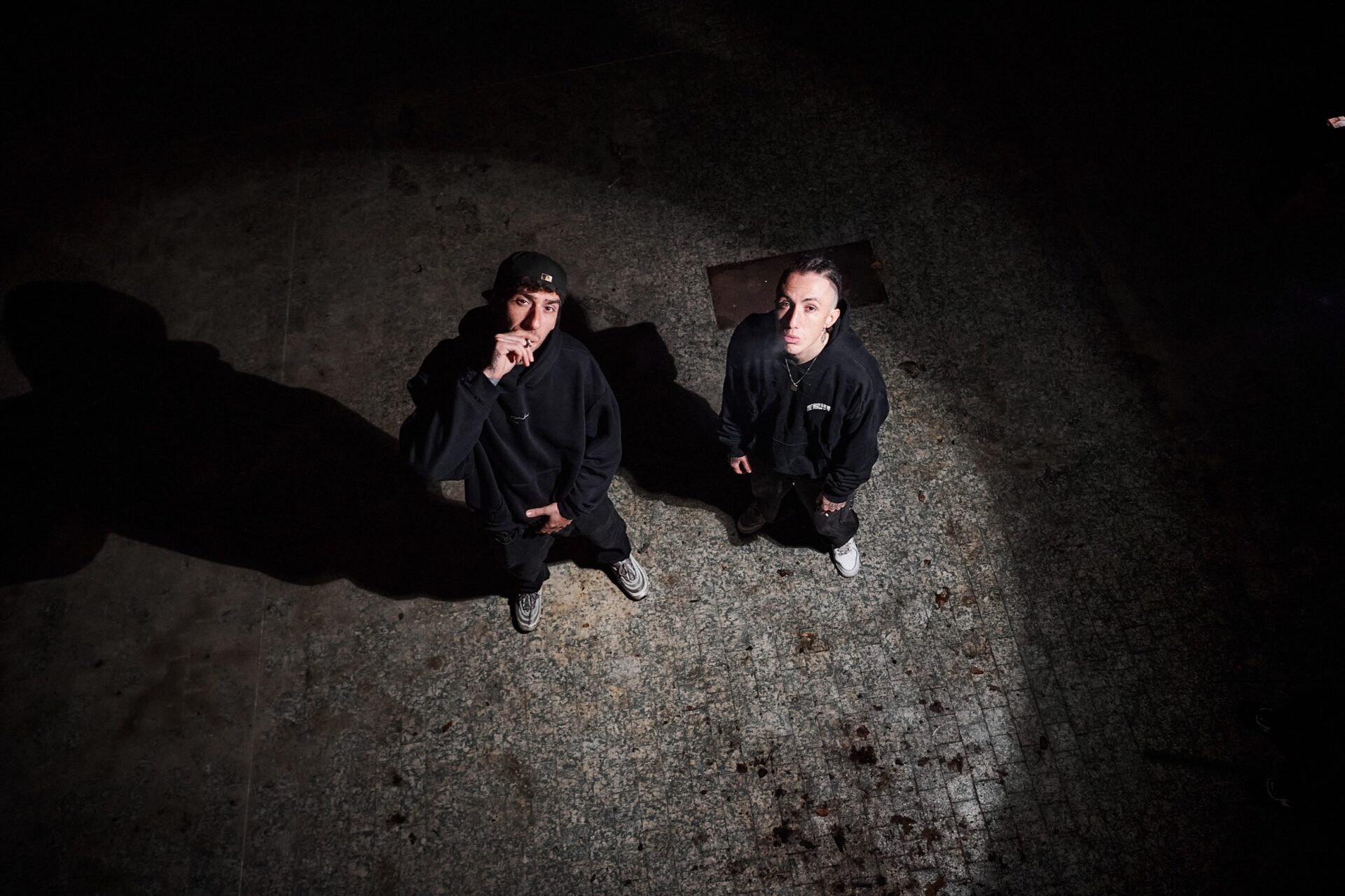
The LYMB Familia: a raw and unfiltered tale of life in the Italian province.
The contradictions and hypocrisies of the Varese province find their voice in the LYMB Familia. Out for a few weeks now with the album “Spirito Santo”, Vmaki and Macrom told us about their journey: from how they met and the first tracks recorded in a garage, to their relationship with Massimo Pericolo and joining Polo Nord, his new label. A real slice of local life amidst brotherhood, small-town bars, stories of those who make it, and those who seek comfort in addiction.
Hey guys. Let’s start from the roots of the LYMB Familia. How long have you known each other, how did you cross paths the first time, and at what exact moment did you decide to give shape to this project together, and what does LYMB Familia stand for?
Macrom: Around here, in the Varese province, there used to be all these hangouts for kids, every town had its own spot and its own crew. I’m from Besozzo, and I used to hang with the others at the lighthouse, a spot here in Besozzo. Then there were the guys from Cittiglio, Caravate, Cocquio, Leggiuno etc… Often there were feuds between kids from different towns, but over stupid shit: maybe a guy from Caravate owed money to someone from Gavirate, or someone hooked up with one of our girls or vice versa. So there was this thing of rolling out, invading the guys from that specific town, and beating the crap out of each other. That was probably the first time we ever saw each other, in those kinds of situations. Then, one time, a friend of mine said he was heading to Caravate, behind the cemetery to meet up with some homies, and paradoxically I met Vmaki along with a friend of his who unfortunately is no longer with us, and we smoked our first joint together. From there, we didn’t see each other again for about ten years. We both already came from rap backgrounds, everyone had their own collective, then always through another friend who doesn’t rap anymore, we met up in Vmaki’s studio — which was literally a garage where it rained inside and he grew weed — to listen to various tracks. From there we started to build a personal and musical bond and we thought about joining forces to create LYMB, which stands for Love You My Bro. For us, it’s family, it’s the union between brotherhood and passion, a creed for those who are always there in times of need.
Let’s take a step back to your musical imprinting. How and when did you approach Hip-Hop and rap in particular? What were the listening habits and influences that shaped you at the beginning, and which ones inspire you today?
Macrom: I’ve always had a passion for music for as long as I can remember. Approaching rap in my teenage years, I got hooked right away, starting to write my first lyrics as streams of consciousness purely to vent; it has always been out of necessity and it still is today. I’m a solitary person and I tend to stay closed off in myself; rap helps me pull out that part of me that wants to hide from the world. I write mostly driven by emotions, for dreamers like me who have no intention of giving up. Hip-hop has always been part of my life since I was a kid; my brother listened to Articolo 31 and the curiosity started from there, only to discover Club Dogo, Fabri Fibra, and it turned into a passion. Later on, I shifted strictly to American rap, listening to A$AP Rocky, XXXTentacion, Lil Wayne, Lil Uzi Vert, and others, while today I’m inspired by soul artists like James Brown, Stevie Wonder, and Ray Charles.
Vmaki: I started listening to rap when I was eight or ten years old. The first thing I remember is Mondo Marcio, thanks to a friend’s dad who was always blasting his record on the stereo. We were little, we went to school together. Shortly after, my sister was listening to Tradimento by Fabri Fibra, with “Vaffanculo”, and that got me even closer to rap. It was a different era: the internet practically didn’t exist like it does today. You downloaded stuff on eMule, with the dial-up connection that cost a fortune, or you passed around burned CDs. I was just a kid and I’d scavenge records from my sister’s older friends. Around thirteen or fourteen, I started writing. We had a somewhat complicated situation at home and, as a kid, I struggled to talk about what I had inside, partly due to some traumatic experiences. My parents wanted to take me to a psychologist, but back then it was still seen in a bad light: it seemed like only crazy people went there. It was the classic “shrink” stereotype and, as a kid, you were also afraid others would talk shit if they found out. So I started writing on paper. I wasn’t even rapping, it was simply my way of venting and managing to express things I couldn’t say out loud. Growing up, I built my own musical culture: Rakim, Nas, N.W.A., Eazy-E, Ice Cube, and the whole West Coast, up to Tupac, who I was almost obsessively a fan of. I remember that, as caught up as I was in the feud with Biggie, I had to take Tupac’s side, so I could barely bring myself to listen to Biggie. As for Italy, I listened to Maxi B, Ape, Palle e Lana, who were from our area, and Fritz da Cat. Then came Neffa, Co’Sang, Club Dogo, and other names in the scene, like Sangue Misto, Articolo 31, and Sottotono. I also listened to Stokka & MadBuddy, Ensi, Nesli, Nex Cassel. Currently, I listen a lot to Clipse, because their new album goes hard as fuck, but also Joey Bada$,AAP Rocky, and Freddie Gibbs. In reality, though, I listen to a bit of everything, even outside of rap: Phil Collins, Oasis, Red Hot Chili Peppers, Sade, Miles Davis, Sting. I just really love music in general. My parents also listened to a lot of that kind of music when I was little, so I grew up with those sounds too and I still carry them with me today.
In your music, you can breathe a very strong attachment to the Varese province. Yours is an unfiltered, real narrative: on one hand, the work ethic and the land rich in businesses, on the other, the darker sides like hypocrisies, drug dealing, organized crime, all the way to drug addiction and depression. How do you live this contrast on your own skin and how do you explain it? How much does it influence your writing?
LYMB (Macrom & Vmaki): We grew up here, so inevitably there’s this attachment to the area; it’s a love-hate relationship. There are days when you want to leave, then when you are, say, in another place for vacation or work, you can’t wait to come back because you feel out of context, like a rat in the city. So we know both the beautiful part of the province and the more rotten one well: on one hand, those trying to live an honest life struggling to make ends meet, without ever getting any satisfaction, and on the other, those living on the streets seeking relief in a dose.
We are inside this reality too, we don’t just narrate it from the outside. And that is probably what influences our writing the most: what we see, what we live. Many people think that not talking about a problem makes that problem not exist. Anyway, rap was born as a tool to denounce hardships and problems; we simply try to tell them without sugarcoating them.
Let’s talk about the latest record, the one under the LYMB Familia banner, “Spirito Santo”. How did this project take shape? Tell us about the genesis of the album, the choices behind the productions, and how you selected the features on it.
Macrom: At a time when we were continuing to pile up singles, we felt the need to create a project out of necessity and bring out our skills. We worked as a duo, word for word, on some tracks, and others we started individually only to finish them together. As for the productions, they were found on YouTube — which by now, as sad as it may seem, has the whole world inside it. We also opted to have beats remade, but every time you do this process you lose the emphasis of the first time, the first rec.
The features are lifelong friends, artists we’ve always known and respected. Some don’t rap/sing anymore, or for instance, there are Vmaki’s nieces. The collaborative tracks with them were born in a completely natural way: for some, we wrote the hook for them and gave a direction, and others showed up with everything already written for their verses.
Vmaki, your solo EP “Luogo di nascita” was for us one of the most valid and dense projects of last year. It also contains very intimate and touching tracks, I’m thinking of “Ultimo Cielo” or “Dove finisce il mare”. What did the release of that record mean to you on a personal level?
Vmaki: For me it was first and foremost a confirmation. I’ve been making music since I was very little and there has always been the passion, the need to express myself. But deep down I also always had that thing of: “Fuck, I wish one day this could also become a job.” Before Luogo di nascita it was more of a dream, whereas with the release of that project, concrete confirmations started arriving. All the grinding done up to that point started bringing results: getting noticed by Massimo Pericolo, getting noticed by the label, getting called… It made me think: “Ok, then maybe I’m not the only one seeing something in what I do. Maybe I actually have a knack for this.” Because when you make music you always have that doubt: maybe a track sounds like a bomb to you simply because you made it, while outside they might think “what the fuck is this guy saying?”. So, when confirmations arrive from the outside, they have enormous value to me.
But Luogo di nascita is important above all because it’s a very personal project. Inside there are things that carried a massive weight for me, like Ultimo Cielo. That track was born at a time when my dad had just died and, initially, I hadn’t even written it thinking I’d drop it. I had written it mainly for myself, because writing has always helped me process what happens to me and let out the things I have inside. Obviously, writing that track didn’t bring my dad back, but it helped me feel a bit better and, over time, I started thinking that maybe that thing that had helped me could help someone else too. And in fact, I’ve had people stop me, maybe even with tears in their eyes, to say thank you because they had lived through a similar situation. And that is huge for me. In a way it makes me think that, even if I couldn’t change what had happened, at least what I turned into music might have been of use to someone else.
Dove finisce il mare, on the other hand, is a slightly different story. It’s a very personal track and I prefer not to get too into the details of what’s behind it. I think some things can remain private and that it’s not necessary to explain everything behind a song. Also because maybe, by listening to the track, everyone can form their own idea. So yes, Luogo di nascitameans a lot to me, regardless of the feedback it got. It’s a project that represents a specific moment in my life and inside it there are both confirmations on the path I’m taking, and very intimate things that helped me personally.
It’s impossible not to notice the numerous and constant biblical and religious references in your lyrics. Why this choice? What is your relationship with God and spirituality?
Vmaki: Look, my relationship with God is quite complicated. I’m not a believer in the Christian sense of the term, but I don’t rule out the idea that there might be something above us, some sort of creator or energy. I like more to think of a force that is inside each of us and that, somehow, gives us the drive to keep going and reach our fulfillment. A bit like the “shining” in Doctor Sleep, to give an example: obviously not in the sense of having supernatural powers, but as something we all have inside and that maybe we can’t even explain well. I consider myself a person who has done a lot of dumb shit and made a lot of choices I’m not exactly proud of. And maybe one of the things I seek through music is exactly that: to arrive, one day, at feeling completely at peace with myself. I think I’ve lost my innocence, but I’d like to reach a point where I can say: “Ok, I’m still a good person, despite everything I’ve done.”
I’m deeply fascinated by the contrast between good and sin, the necessary evil — like having to do something out of necessity because the situation doesn’t allow for anything else, which is what we live — or the concept of redemption. In the Bible and in religion, these themes are very present and I tried to transport them into today’s world, into the reality we live every day. So the religious references in my lyrics aren’t so much a way of saying “I believe in this,” as much as a language that allows me to talk about very human things: guilt, sin, good, evil, the desire to change, and the possibility of being forgiven or forgiving oneself.
Vmaki, looking at your solo projects, like “Se dio vuole” and “Luogo di Nascita”, the collaborations with heavyweight producers like Sick Budd and Garelli stand out. How did these connections come about and how important was the studio work in Milan for you, both to refine your sound and on a human level?
Vmaki: I already had some contact with Sick Budd back in 2015-2016, when I wrote to ask him for info about the studio. Then, when we were working on “Se dio vuole”, I think it was 2021 or 2022, I wrote to him again and sent him some demos. He liked them and told me to drop by the studio. From there we got to know each other better and started working together. I went to Milan to his place practically once a week, or at most every two, to record and produce. A beautiful relationship was formed, which goes beyond just music, and I love the guy; at that time I was also desperate because I was dead broke and he always gave me a hand in the studio. I respect him immensely as a producer and he was a huge help to me, just like the whole Bullz Records team. Sick Budd, in particular, helped me a lot to refine my flow and grow musically, even in the moments when maybe we just had a break between one session and another. One of the things I liked most was exactly the creative process in the studio. Maybe we’d start without a precise idea, we’d grab one of his vinyls, pick one, put it on the turntable and start sampling. Something would come out from there. I always loved that way of working, that synergy that is created when you’re with someone you share a certain musical language with. With Garelli, on the other hand, the dynamic was more or less the same: I had sent him some demos, he listened to them and we met in the studio to make music. It happened a bit by chance, but it was great to be able to work with him too. Lately we talk much less, maybe almost not at all anymore, but I think that’s normal, everyone has their own things to do.
Your path is closely intertwined with that of Massimo Pericolo. Vmaki, you have a very deep personal relationship and an obvious chemistry with him, which is clearly perceived in “Dove finisce il mare”: how did you meet?
Vmaki: Actually, I’ve known Massimo for a very long time. We met in a pretty rundown bar around here, completely drunk. Probably my opening line to him was something like: “I’m wasted, let’s go drink some vodka.” He was also just starting out at the time, making music like me, so we met in that context. Then we each went our own way. Not because there was any issue, simply because when you make music it’s hard to even manage to link up. Maybe you say “come on, let’s do a track together”, then you do one, time passes, other things happen and in the end it gets complicated to reunite.
In the meantime, I continued on my path. I shot my videos, dropped my shit, tried to be consistent and above all to keep improving. I think he saw exactly that: the dedication I put into it and the fact that, despite everything, I kept making music. At a certain point we reconnected and from there the relationship changed. Now he’s taking me on tour with him, we’ve created a very strong bond and I truly love him to death, also because he gave me an opportunity that definitely isn’t granted and that not everyone would have given. Dove finisce il mare was born practically by chance. I had to finish Luogo di nascita, I dropped by the studio and he was there too. I had put the track on the computer, but I only had the first verse and the chorus. He listened to it, looked at me and said: “Fuck, this is a fucking hit.” And in the end he hopped on the track. So it was born very spontaneously, like so many of the best things that have happened to us musically.
How was your label and crew Polo Nord born, what does it represent for your area and what can you tell us about its future?
Vmaki: Polo Nord was initially born from Massimo’s idea to create a label and build something of his own. I let him hear my music, some demos and some singles, including some tracks that would eventually end up on Luogo di nascita, and from there the thing started to take shape. MP and XQZ went to the accountant, set all the bureaucratic part in motion and I became the first artist on the label. It all happened naturally on its own, bureaucratic part aside. For our area the feedback has definitely been very positive, I think mostly because what we do is something very real and very human. We aren’t egomaniacs: we are small-town kids, with our experiences, our problems, and our way of living things. We talk about current situations, about things we know and actually live, and maybe that’s exactly why those who listen to us can recognize themselves in it.
For the future there’s a lot in the works. Surely one of the most important things will be to continue giving opportunities and a voice not only to us, but also to other kids in the area who have something to say and maybe haven’t had the chance to be heard yet. There are already several projects in motion, some of which I’m not authorized to talk about, but which you will definitely hear about. Let’s just say Polo Nord is just at the beginning and I think it can become something much bigger than what it is today, without losing this provincial crew identity.
Looking at the current rap scene, where do you feel you fit in? Do you have the feeling that you deserve a different space, or perhaps a bigger one, compared to what you are granted today? And finally, what are your next plans, both as a collective and on an individual level?
Macrom: We definitely feel we deserve more, I wouldn’t know where to place myself, maybe I’ve never reached a large audience and it’s hard for me to judge for myself. We certainly have the skills to be at a higher level and we’ll see. As for the future, there are already projects we are working on as a collective and also, individually, a few singles ready on the PC.


