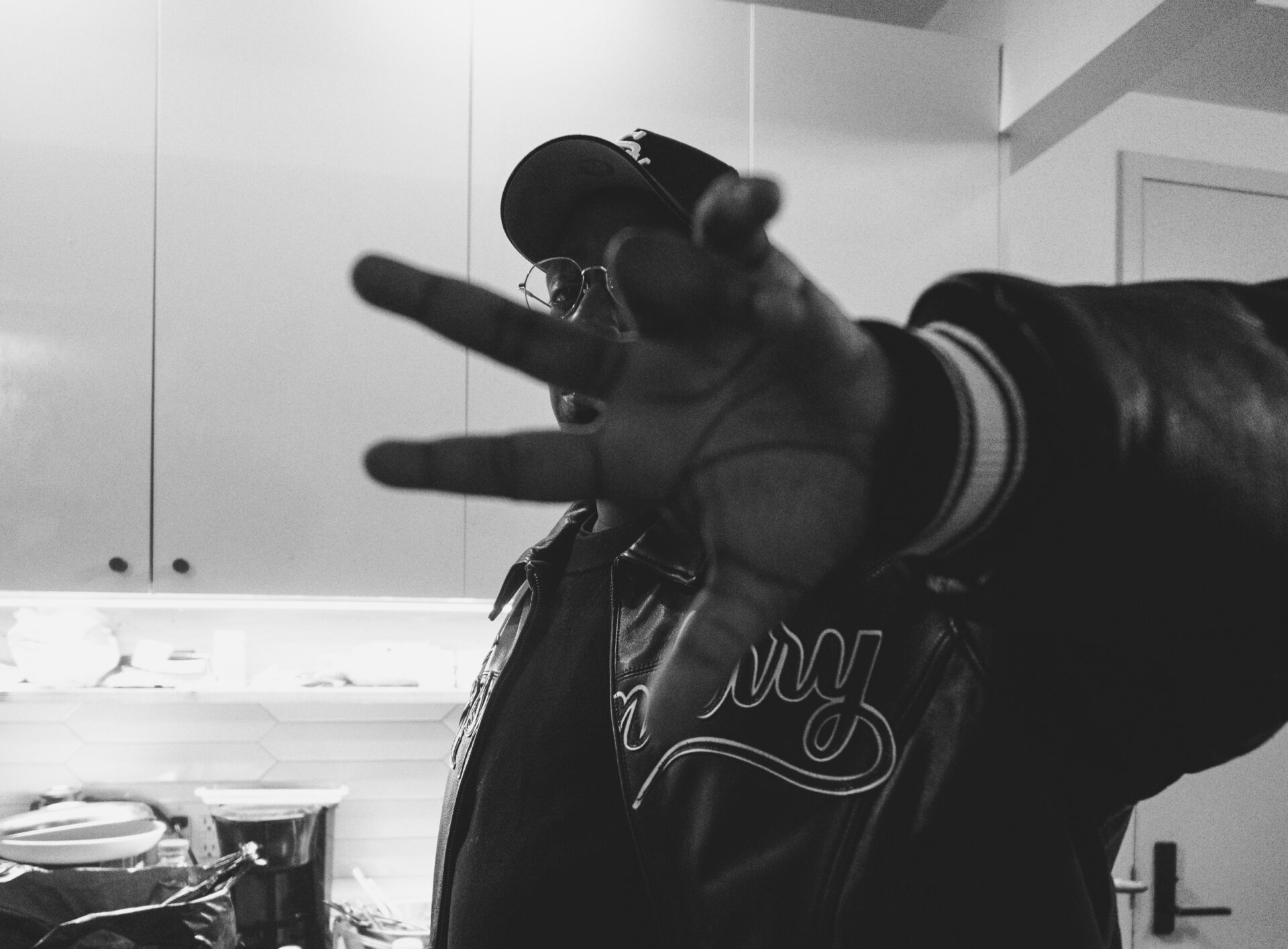
Superior: «It’s never about the name, it’s always about the talent»
The Spanish-blooded, Germany-based producer Superior has spent the last decade crafting cinematic, often drumless soundscapes for artists like Eto, Estee Nack, and Che Noir, earning recognition that spans from the US east coast to Buenos Aires. His approach,rooted in sample wizardry, drumless loops and monumental atmospheres, inspired by masters like RZA and Ka (R.I.P) has forged its own path. In this conversation, Superior discusses the art of production, his growing connection with South America’s rising rap scene and previews upcoming projects including the highly anticipated follow-up to Baladas with Estee Nack. This is the story of a producer who, through his passion for underground hip-hop, refined taste, and relentless drive, has built a name for himself across both sides of the World.
-
 Long Story Short [x Eto]2019
 -
 Baladas [x Estee Nack]2020
 -
 Sleep Is The Cousin [x Vega7 The Ronin]2023
Thank you Superior for your availability. You have the merit of having carved out a role for yourself in the American underground scene for about ten years now, despite being European and specifically German. So, tell us about your background. Which part of Germany are you from and how would you describe the German Hip-Hop scene and in what way has it influenced your artistic journey over the years?
I ain’t German, man — got that Spanish blood in me. I just live out here in Germany, ya feel me? To be exact — Heilbronn City, down south. What I can say about the German hip-hop scene is this: back in the day, all the elements used to come together at the jams — MCs, DJs, writers, b-boys — the whole culture.
Germany used to have some of the most frequent jams worldwide. But nowadays, that vibe’s almost gone — barely any real events left. And honestly, the German scene didn’t shape me musically at all, ‘cause I was always bumpin’ that U.S. rap, straight from the source. Most German artists still look across the pond, tryin’ to do the same thing, just translated into German.
What were your first steps in the art of beatmaking? What were your main influences and inspirations in the beginning? Is there a particular record that made you say “I want to do this”?
I’d say the real moment I decided to take beatmaking seriously was back in 2014 — that’s when I’ve copped the Maschine. A year later, I dropped my instrumental album Scenes. But the truth is, I’d been makin’ beats way before that.
What inspired me was hearin’ a lotta beats out there and thinkin’: “Yo, I can do that better.” Whether it was the drums, the basslines, or the way cats were choppin’ samples — I just knew I had my own flavor. One of my biggest inspirations for what a perfect beat should sound like was GZA’s “Shadowboxin’.” Man, I love that joint. What RZA did with that sample? Pure genius — straight unbelievable.
Were you self-taught or did someone pass on the first rudiments to you, showing you the basics to start this journey? And in the first case, what allowed you to refine this craft?
I taught myself everything, man. When I was eight, I got a guitar and took some lessons. Later on, I picked up the keys on my own. I think I got a real musical ear — and on top of that, I put in hella practice. That’s how I kept leveling up, getting better and better musically.
Your name burst onto the radar of the worldwide underground scene when you produced the entirety of “Long Story Short” for Eto in 2017. A phenomenal project. How did that project come about? How did you manage to cross the ocean with your productions and get noticed by a strong rapper like Eto from Rochester, NY?
I connected with Eto through SoundCloud.Up ‘til that point, I was mostly makin’ traditional boom bap beats. But when I heard Eto, I knew he needed somethin’ special — somethin’ darker, rawer… a lotta joints with no drums, so he could really paint his picture over the instrumentals. Then I sent him my beats — and the rest is history. That’s when a new chapter started for me, steppin’ into that grimy rap lane.
What drove you to look towards the American underground scene rather than focusing on the German one? Was it a deliberate choice or did it happen almost by chance?
That was a straight-up conscious decision. I mostly listen to rap from the States, hardly any German rap at all. Ain’t really nothin’ comin’ outta Germany that blows me away like that. There’s no German Ka, no German Roc Marci — nobody that brought their own lane and kept it solid. Most MCs out here switch it up — one day it’s dark and grimy, next day it’s some commercial vibe. Ain’t too many that really stay true to their sound. There’s a few exceptions, and yeah, some of that stuff is cool… but still, nothin’ that truly knocks me off my feet.
In fact, do you think that you’ve also paved the way for other Europeans in the US underground scene ? What do you think were the main obstacles and challenges you faced as a European producer trying to make a name in America? And have you noticed any cultural differences in terms of creative approach, work ethic, or workflow when collaborating with American rappers compared to German or European artists in general?
I can’t really say if I paved the way for other Europeans, but what I can say is that the Americans showed me mad love from day one. They really appreciate what I do. There were zero barriers, no weird energy at all. The coverage in the States has been crazy too: I’m even mentioned in the March issue of Rolling Stone magazine. I mean, what more can you ask for, right?
As for working with artists from the States compared to MCs in Germany — the Americans move way faster, lol. I send ‘em a beat, and a lot of them start writing the same day. Couple days later, the files are already in my inbox. Not everyone’s that quick — but most of ‘em are.
After “Long Story Short”, the success of those productions led you to create another underground classic: “Baladas” with Estee Nack. What can you tell us about this album and what was it like collaborating with Estee Nack? What made that project so powerful? Was there a particular chemistry or special creative understanding, did you expect a result like that and what was Nack’s reaction to the album?
Estee Nack caught my attention real early. The way he raps is unique — nobody sounds like him. We speak in Spanish too, which adds a whole different vibe to it. I just knew workin’ with him was gonna be somethin’ special — my gut told me that from the start. Nack was happy with the result as well. That’s why we’re workin’ on the second part right now.
In this 2025 you produced “Seed in Babylon” for Che Noir and “Blood on Earth” for Argentinian rapper Sirio. These are two very different projects – a veteran from the Buffalo scene and a rapper from Rosario, Argentina. What can you tell us about these latest albums entirely produced by you? How did these connections come about and what distinguishes them from the rest of your previous production?
I’d had Che Noir on my radar for a minute. For me, she and Rapsody are the best female MCs out right now. So collabin’ with her was a big goal of mine. I hit her up on IG, and we decided to make an album together.
With Sirio, it was a bit different. I was chillin’ at home on the couch, scrollin’ through IG, then I came across the video for Crime City — instantly blown away. His rap style reminded me of Roc Marci… but in Spanish. I hit him up on IG right away. For me, it’s never about the name — it’s always about the talent.
I’d say every project is different. It depends on who the MC is and what the album concept is. For Seeds in Babylon, I knew it had to be soulful, gospel-influenced. For Sons of Sybaris, I knew it had to sound monumental.
“Sons of Sybaris” with Sirio has achieved good numbers on streaming platforms. What attracted you to the South American hip-hop scene? Do you feel there’s a particular affinity or receptiveness to your production style in these countries? And how do you see the evolution of the underground rap scene in South America compared to the American and European scenes you’re more familiar with?
“Sons of Sybaris”is a unique project that I’m really proud of. For the whole soundscape, I sent all the beats to Sirio — and he didn’t reject a single one. He told me, “the sound is perfect,” and within a month, he had everything put together. The whole process came together super organically and it holds a special meaning for me. In Argentina, the project was received really well — we even got nominated for a major music award as Best Album.
I’d say the Argentinian scene is way more into that style than the German one. There are a few artists in Germany now who are doing that sound too, but when I started, I was one of the very few pushing that vibe.
South American artists are way more familiar with this sound, they’ve been doing it for a long time. In Germany, a lot of people still don’t get it. Some even joke like, “Did the producer forget the drums?” not realizing it’s intentional, it’s about giving the MC more room to express himself. They just don’t wanna understand, smh. The development in South America is mad interesting right now — there’s a lot of strong artists coming up. Sirio, Mir Nicolas, and of course Lil Supa — they’re all playing in the Champions League. Working with MCs on that level really inspires me.
What are the other projects that you think really launched you in the scene? And above all, which ones are you most attached to, perhaps even beyond the success or recognition they received?
The real breakthrough for me in the scene was Long Story Short with Eto. That’s when I started gettin’ real recognition.
I was gettin’ beat requests and props almost every day. Even my follower count on IG basically exploded. Before Long Story Short, I had like 1,500 followers. After the project with Eto? Almost 8,000.
“Sleep Is The Cousin” with Vega7TheRonin is definitely one of your most appreciated projects in recent years, even though initially it perhaps flew a bit under the radar. That record helped shine a light on one of the most underrated MCs in the underground scene. How did you discover his talent and what drove you to choose to produce an entire album with him and why doesn’t his name have the resonance it deserves? And in general, do you enjoy the role of “talent scout”, seeking out and discovering emerging talents to showcase with your productions?
I met Vega through the artist Craig Dyer. Craig Dyer does amazing cover art for a lot of rap artists. He posted the cover for The Lead Lined Wall, and I asked him, “Yo, who’s this?” He told me, “This dude’s an insane MC.” I checked him out right away, and Craig connected us. “Craig, big thanks for that, man!”
Vega’s name doesn’t get the recognition he really deserves, because he’s different from the rest. He’s like Ka. Or like Picasso when he first brought out Cubism. Most people don’t really understand true art — it takes years for them to even start getting it.
And when it comes to scouting talent, I like working with real artists. Talent matters way more to me than a name. It’s all about the art.
My latest single, La Muerte de Efrit, is with an insanely talented artist named Ill Venezia. At the time of the release, she didn’t even have a Spotify account — didn’t matter to me at all. She’s ridiculously talented, and on top of that, she’s a genuinely good person. That’s what matters most to me when I collaborate with someone.
How has your approach to production evolved over the years? Has your working method changed from 2017 to today? What tools do you use to produce and how has your setup changed over the years? Is there something you’d like to explore or experiment with in the future from a sonic or technical perspective?
The approach to a project is pretty much always the same. Before I work with someone on a project, I gotta sit down with the other artist and figure out where we’re headed. What’s the concept of the project? Once that’s clear, I start crafting the sound. I’ve been working with the Maschine Studio since 2014 and I’m really happy with it. What I’d really like to do is be there during the rap recordings too, just to give that final touch and polish.
Your productions often have epic or dreamlike tones, and your projects feel like the soundtrack to a film, transporting the listener into the artist’s imagery and making your sound unique and unmistakable. Was standing out and distinguishing yourself from other producers a conscious objective, or did your signature sound develop organically through your creative process?
It’s got something to do with the concepts behind the albums. Like, if you take Sons of Sybaris, it’s about the story of the ancient city Sybaris, founded around 720 B.C. To me, that needed a historic, monumental kind of sound — something epic, you know? So that’s exactly what I went for. But I also just love those big, monumental vibes anyway, so it all came together pretty naturally.
Drumless production, slow grimy beats and sample loops are some of your trademarks and characteristic elements of the wave launched by Roc Marciano, Griselda and others… Do you envision new trends and directions that will shape the underground hip-hop scene in the coming years? And do you think this style has reached its peak or is there still room for innovation within this framework?
Drumless productions have been around since the 80s. There’s an old EPMD joint on a mixtape from the 90s that’s completely without drums and I’m not talkin’ about Listen to My Demo. There’s this ancient tape they dropped back then, and that track’s on it. But EPMD weren’t the only ones doin’ it, a few cats were on that wave too. You got fully drumless joints where there ain’t even drums in the sample, and then you got ones where the sample got drums in it, but the producer doesn’t add no extra drums — still gets called drumless. RZA did some of that too. His most famous one is All That I Got Is You with Ghostface.
Then around 2010, Roc Marci and Ka took that whole drumless sound to another level — almost their whole catalog around that time had that vibe. Ka dropped like eleven albums and almost all of them are straight-up drumless. My style kinda moves in that direction too, but I still keep my own signature.
Trends come and go — same as everywhere else. But right now, the scene feels a bit stuck. I barely hear anything new. Just stuff that sounds like I’ve already heard it a thousand times. There’s always room for innovation, but honestly, not many people are truly innovative from what I’m hearing. We’ll see what the future brings.
Speaking about the tragic loss of Ka for his family, friends and also for the Hip-Hop Culture. Can you speak openly from the heart about what this artist meant to you personally and what his legacy represents for the hip-hop community? For younger listeners or those who may not be familiar with his work, how would you describe Ka’s importance and influence on underground hip-hop and on your own artistic journey?
Ka is one of my biggest inspirations ever. I’ve mentioned him in every single interview I’ve done. I’m pretty sure no artist has mentioned him as many times as I have — 100%. Ka’s music was truly one of a kind. He wasn’t from this world. His beats, his delivery, his lyrics — just pure brilliance. But what really blew me away was his mindset. He just wanted to make music. A pure artist.
He preferred to work alone, like on his last album The Thief Next to Jesus, he produced the whole thing himself, no features. Or sometimes just with his closest people. He even turned down collabs from legends like Sean Price. That’s how much he valued the art itself.
His wife is the Chief Creative Officer at Pharrell’s company i am OTHER, and she’s got endless connections — but Ka never wanted to use any of that to his advantage. He worked as a firefighter and didn’t want to depend on music for money. That’s why his art was so pure, made straight from the heart, not for profit. He loved the craft so deeply, man. That kind of integrity is rare these days. Ka was, and always will be, my favorite.
R.I.P. King.
What are the upcoming projects in the pipeline that you can share with us? And to conclude: if you could choose freely, who are the 3 current rappers you’d like to produce an entire album for?
I’m working on a few projects right now. One of them is the follow-up to Baladas. Three current rappers I’d love to produce a full album for? My biggest dream was Ka—sadly, that’s no longer possible. R.I.P. king. Then there’s Roc Marciano, and a full album with Stove God Cooks, with whom I’ve already done a 2-track EP.